Friday, January 19, 2007

BOJ Keeps Rates the Same

The Bank of Japan decided Thursday to keep interest rates unchanged. Where will the Japanese economy go? Will BOJ raise rates later?

Bank of Japan keeps benchmark interest rate unchanged
Mainichi Shimbun, January 18, 2007

......The central bank is independent, but political opinion has been known to influence policy in the past. Bank of Japan Gov. Toshihiko Fukui brushed off such concerns, saying the bank was only looking at economic factors, and denied a media report that the bank had informed the government of its decision in advance. "There is no change in our stance that we will gradually adjust interest rate levels depending on changes in the economy and prices," Fukui told reporters.

While it said the economy was "expanding moderately," the bank's report pointed out that both economic growth and consumer prices have fallen below its last forecast, in October, mainly because of weaker-than-expected consumption.

.......Economy Minister Hiroko Ota also sounded a cautionary note, noting that Japan was still trying to beat deflation, or falling prices, which dragged on Japan's economy for years. The nationwide core consumer price index rose 0.2 percent on year in November, the sixth monthly increase. The Bank of Japan faced similar political warnings last July -- but went ahead and raised interest rates for the first time in six years to 0.25 percent from virtually zero. Government officials repeatedly denied that the government had placed any pressure on the bank.

......Chief Cabinet Secretary Yasuhisa Shiozaki stressed the autonomy of the central bank. Politicians were just exercising "freedom of speech," he told reporters. "Various people are saying various things in their positions," Shiozaki said. "How the central bank can maintain its independence is ensured by law." But analysts warned that the perception of political meddling in monetary policy could make international investors reluctant to commit money to Japan. Still, given the recent less-than-robust price and consumption figures, he believed the bank made the right decision.

Considering low price and low consumption in Japan, the decision of BOJ is right. The problem I think most important is when the Japan will recover from a still-stagnant economy. As long as a groomy economy continues, BOJ will keep interest rates unchanged. But as Mr.Fukui said, BOJ will raise the rates if the Japanese economy recovers in the future. In this regard, it is the problem when the economy gets stronger.

What makes the economy stagnant? The low demand does. Or the low consumer's confidence does. What would stimulate the confidence? Much money supply would do.

In this point, I don't intend to imitate the Krugman's treatment for the stagnation of the Japanese economy, but I think one of the policy measures is for BOJ to supply more money into the economy until it recovers. As a macro textbook says, it will work. Now the government can't cut tax rates any longer because it has a large budget deficit and debt. In this case, if the government spends more, the people will fear the health of the budget and the future tax increase. This would be a negative effect on the economy. This situation is not hopeful. And then BOJ has no reason to do nothing. BOJ should conduct actively expansionary monetary policy to kill the deflationary pressures on the economy. Now is the time not to raise the rates.

Moreover I don't hope the government will say about whether and when BOJ should raise the rates. Many people might become doubtful about the independence of BOJ and thus the health of the financial system in Japan.

Thursday, January 18, 2007

How to Promote Happiness

I found an interesting post in a famous American blog, Freakonomics Blog, "The secret of Happiness". Today I'll introduce it and my thought about it to you. Here's the excerpt:

Among the most intriguing happiness theories I've come across,... asserts that the citizens of Denmark are happier than their European counterparts, even though they rank high in the kind of things that are typically affiliated with a low happiness rank, like bad weather, bad food, and high alcohol consumption. So what’s their secret?

Low expectations. ... If you’re a big guy, you expect to be on the top all the time and you’re disappointed when things don’t go well. But when you’re down at the bottom like us, you hang on, you don’t expect much, and once in a while you win, and it’s that much better.”

This theory makes sense to me, just as it makes sense that people who earn a few thousand dollars more than their colleagues say they are happier than if they were earning more money but less than their colleagues. As with many things in life, relative happiness may be far more important, or at least measurable, than absolute happiness.

This is a very interesting post. When I saw this, I wondered if the government could promote the people's happiness by using the policy tools.
How can it do that? Is this a ridiculous imagination, isn't it?

Happiness is, in my view, thought to be greatly related to an economic gap between the poor and the rich, as once John Kenneth Galbraith, an American economic thinker, wrote in the book, "The Affluent Society". Some politicians in Japan say that the most serious economic problem we now face is an increasing economic gap. Certainly many people dislike to find their income lower than their neighbors and tend to think that an economic gap is a problematic issue.

But this wouldn't be always the problem that harms our social life.(Some economic researches report that a widespread economic gap would cause a decreasing economic growth and our welfare, however.*1)

I wouldn't like to conclude here that an increasing gap leads to lower economic growth and it is the most serious problem, because this view depends greatly on either how the economic model will be built or what people value more in their society. If our policymakers were worried about how happy we were, they might try to decrease an income gap among us by manipulating the tax system as long as our happiness was more related to an income gap. However, if our wise policymakers found out that happiness was not related to an income gap but, for example, low expectations, they might try not to remedy the gap but to force the people to get satisfied with their present social life by controlling the minds as once conducted in most Socialist countries.

When I hear the voices that our policymakers should try to remedy the income gap, for what should they do? For our happiness? It is very unclear, I think. If it is for happiness, should they remedy the gap? After all, can the policy promote our happiness?

*1 A quotation from the Wikipedia:
Robert Barro wrote a paper arguing that inequality reduces growth in poor countries and promotes growth in rich ones. A number of other researchers have derived conflicting results, some concluding there is a negative effect of inequality on growth and others a positive. Patrizio Pagano's research suggested that inequality had a negative effect on growth while growth increased inequality.

Tuesday, January 16, 2007

A Great Thinker Knew Sunk Cost

09/10/2010 revised

A Great Thinker Knows Sunk Cost

I'll take up the word of Confucius. As you know, Confucius is a great Chinese thinker. In East Asia, he has greatly influenced the minds and thoughts of the people. Hearing his name, I always recall the following words:

At fifteen my heart was set on learning;
(十五向學)
At thirty I stood firm;

(三十而立)
At forty I had no more doubts;

(四十而不惑)
At fifty I knew the mandate of heaven;

(五十而知天命)
At sixty my ear was obedient;

(六十而耳順)
At seventy I could follow my heart's desire without transgressing the norm.

(七十而從心欲,不踰矩)

I believe that he had a special ability to know all the things governing the world, and that he was not only a philosopher but also an economist.

A philosopher clears up the laws governing the world and the society, whereas an economist finds out the ways of governing the economy and the market.

Let me show you the reason he was an economist: He knew the idea of sunk cost. Sunk cost is the one that has been committed and cannot be recovered. Most economists tell us to forget a sunk cost when we begin to do something new, because we cannot avoid it once we incur it.

The following word has been said for long in the Western society, "Don't cry over spilt milk"., whereas our Confucius gives us the next one, “Forget injuries, never forget kindnesses.” I like it better. This is the Eastern version of spilt milk.

Monday, January 15, 2007

A Small King

More than 2,000 years ago, there was a small country next to the Han Dynasty in ancient China. One day an ambassador of the Han went to see the king of that country. The king asked the ambassador one naive question:

Which is the larger country, mine or yours?

Then the ambassador said nothing.

This is the king who doesn't know the world. Who is the person like that king in our world?

Sunday, January 14, 2007

Cakes and Puddings

A review for a crane-tortoise figure:

I bought cakes and puddings, which were 15 in all. And I paid $14.40. A cake was sold for $1.20, while a pudding for $0.90. How many cakes and puddings did I buy respectively.

Don't use the letters x and y.

Cranes and Tortoises

Recently I have been into arithmetic, a primary mathematics which is taught in most cram schools for the elementary school's students proposing to the prestigious junior-high schools in Japan. Don't make light of it! It is harder than we might first expect.

One of famous problems in arithmetic is on figuring the number of cranes and tortoises from the total of their legs. We call it a "crane-tortoise figure". (However I can't find the official translation of it.) This problem originally comes from a Chinese old math book written in more than 1,500 years ago. See the following problem:

The total number of cranes and tortoises that we have is 8. And the total of their legs is 26. When cranes have two legs and tortoises four legs, answer the number of cranes and of tortoises respectively.

By the way, I posted another problem related to a "crane-tortoise figure", an age figure. Of course, because it is a problem of arithmetic that the children under 12 would try, you mustn't solve it by using the first-order equation. Let's have a try!

Saturday, January 13, 2007

Excercise: How Old Is My Brother?

I have two brothers. I would like you to answer the present age of the one of them:

In 8 years later, the age of my mother will be four times that of my brother. The difference of their ages is 37. Answer his present age.

Solution: How Old Am I?

On January 6th, I asked you how old I was. To solve this problem, you should keep in mind the following statement:

Now I am 32 years younger than my father. I will be half as old as my father in six years later.

According to the above, when I was born, my father was 32. When I am 32, my father will be 64 and then twice my age. It is 6 years later that the age of my father will be twice as old as my age. That is, I will be 32 in 6 years later. Here you'll be able to answer my present age;


32 - 6 = 26

Hence my present age is 26.

Friday, January 12, 2007

Have a Break!


Kit Kat is my favorite chocolate sweet. Here's the excerpt of the ad:
This product was developed as a four-finger wafer crisp, initially launched in London and the South East in September 1935 as 'Rowntree’s Chocolate Crisp' and re-named two years later as KitKat Chocolate Crisp. It became KitKat after the Second World War. No one is sure where the name KitKat came from but it’s thought the famous KitKat Club of the 1920s had some influence.
In Japan, Kit Kat is a lucky charm for the success in exam. The reason is that it rhymes with "Kitto Katu", a Japanese happy phrase, which means "you will surely win".
January is the month for the school entrance exam for all the proposed students. I hope they will be able to pass the exam happily. Before you take the exam, have a break and have a Kit Kat!

Saturday, January 06, 2007

How Old Am I?

Today is my birthday.

Now I am 32 years younger than my father. I will be half as old as my father in six years later. Answer my present age. Don't use the first-order equation to solve this problem!

Monday, January 01, 2007

A New Year's Policy Requests

A new year has already come to us. In Japan today is a very fine day and the sunshine is brighter than usual. The future of the rising sun is also likely brighter than ever before.

However, I think we have many several serious problems to be solved as quickly as possible. Let me mention three solutions for them, especially: (1) BOJ should supply more money and (2) MOF should raise the tax rates and cut the expenditures. Moreover, (3) MOF should raise the consumption tax.

(1) Raise the demand of the economy.

In terms of GDP, employment and consumer price, Japan is seemingly recovering from the long deflationary economy. But it is still stagnant. This new year is the striking year when many retires will come into the economy. Although some of them are expected to spend money and to create new demand in the economy, many of them might cut the spendings on goods and services to remain their standard of living. If so, the whole demand shrinks and the recession comes again. Such a problem of the aging economy is inevitable. What will we do?

I would like the Bank of Japan to rather increase the supply of money to keep the economy stable. Some economists fear that inflation comes if BOJ supplies more money. But rather I am afraid that deflation comes again if BOJ supplies no more money and raises the interest rates. Inflation is a terrible economic phenomenon, which devaluates the yen and loses the credibility of the BOJ and its monetary policy. At the same time, deflation is also a horrible one, which appreciates the yen and the debt and induces them to hold money and not to spend money. We must increase the demand to avoid any deflationary phenomenon.

(2) Cut the fiscal deficit.

The path of Japan's fiscal policy is unsustainable. At present, Mr. Abe tries to cut the corporation income tax to activate the operations of company. Some fiscal economists and policymakers say that the supply side of the economy would be strengthened if the tax was cut. That is, they say that companies would enhance the production ever more if tax was levied less. I hope that the demand will, to some extent, increase due to tax cut. In this point I agree to that tax cut plan. But when tax cut is done for the purpose of increasing the corporation production, I don't agree because it is uncertain whether the tax induces companies to raise the output.*


* Theoretically, whether the corporation tax cut boosts the production depends on the elasticity of the production supply, which means how many goods and services company would increase if one unit of tax rate was decreased.

Now the production supply in Japan doesn't need increasing as I've told before in this blog. If many policymakers cut the income tax to activate the supply side of the corporation activities, they should not do that, I suggest. Now policymakers should raise the tax rate to cut the fiscal deficit first. To raise the rate, the demand will decrease. This is an adverse effect. And so, as I told earlier, BOJ should increase more money not to keep the economy down.

If tax rate is raised, more people come to think the path of the present fiscal policy less unsustainable and worry less about their future. According to the life-cycle theory, they spend more money because they are less uncertain about their future. The main reason for the present stagnant Japanese economy is their anxieties about their future living. Their worry about future makes them tighten their purses. The Ministry of Finance of Japan needs to show up the health of the fiscal balance to the Japanese people to make them loose their purses. And so it should raise the tax rate and cut the expenditure in spite of the negative effect of these policies on the economy.

(3) Fix the public pension plan.

In the longer run, the present public pension system needs fixing. This topic is closely related to the above my policy requests in terms of saving more.

In Japan the amount of saving is decreasing due to more aging people. Saving is necessary for the economy to keep its growth stable. So my third policy request is to raise the saving in Japan. Raising the saving is neither more nor less than those ones of raising the tax rate and cutting the expenditure.

For them to save more, the present public pension plan should be revised. In our present pension plan, we have to send our money to the pension fund and in several decades later we will receive the benefit. However, these days the premium on the young is going up and the benefit for the old down. It is very natural because the present plan is the system of "pay-as-you-go", which forces the young to pay for the old through the fund.

The main problem of the system is, needless to say, that the number of young people to pay is decreasing and the number of old people to receive increasing. The old people can receive neither more nor present benefit unless we the young people pay more. To keep the system sustainable, the premium should be raised and the benefit should be cut. Such a system is unattractive and unsustainable in the aging society. That's why I suggest the pension plan should be fixed earlier.

The idea of the public pension plan is very nice because we can spend the money as we get old and retired. To remain the same plan, the new tax should be levied on the whole people in Japan for the pension plan. Some economists have already been suggesting such a policy to raise the consumption tax and I agree to the tax plan for the public pension plan.

I would like MOF to raise the consumption tax rate to keep the pension plan alive. By doing so, we don't have to fear that the pension fund might collect far more premium from the younger people and cut the benefit for the old people.* To put it precisely, the consumption tax rate should be raised not for the healthy fiscal balance but for the healthy pension plan. Moreover, if the consumption tax is increased, the saving increases and the economy grows enough for us to make a good and happy life.

*However, we will have to pay more tax and have some hardship if the consumption tax revenue compensates for the pension plan.

To sum up, I would like BOJ to supply more money and MOF to raise the tax rates including the consumption tax and cut the expenditures. It is the best policy mix that we now need most.

Sunday, December 31, 2006

A Land Of Opportunity

The United States - the country which I've ever wanted to visit, is my new year's primary resolution: Next year I may go to the US if I pass the application processes to the graduate school. The United States is called "a land of opportunity". So is it to me.

In the US, I will do the following five things;

(1) I will think and talk more positively about politics.

In Japan I have thought and talked about politics. However, I couldn't be inspired by discussing politics at an intellectual place. At the graduate school which I went to, there were many students who I thought had a lot of knowledge of social science, but it seemed they usually avoided discussing politics with other students. It was likely politer for them not to bring political matters into their discussion. In some cases, it may be politer for them to do that, but in other cases, it may not be. I think an intellectual place like a university should be the free place for political and social discussions.

(2) I will broaden my perspectives on the activities in an international society.

In the US, I'll have many chances to see what I've never seen before. In some cases, I may have to know more what I've never known. In other cases, I may find I've ever done wrong things. My value judge would be changed in an inter-cultural circumstance. I hope I will change myself among many other international students to remain the same myself.

(3) I will devote myself to the researches of economic theory.

I've studied economics for about 5 years at my undergraduate and graduate school. For those years I may have taken a roundabout way to the pursuit of economics: In fact I stopped studying economics and worked for a company at one time. I gave up seeking a career of economist which I had hoped to be because I thought it very difficult to become an economist. Certainly it is very hard to make a living as an economist in any countries other than Japan and the US. But, during my several months of work experience, I came to think the possibility of becoming an economist depends on how firm my will is. I found I had to try as hard as possible.

(4) I try to know more about the US as well as Japan.


When I am in the US, it is waste of time for me not to try to know more about the way of life in the US. I want to know about the life and politics of the US if I can live in the US. This is very valuable chance that I think I will never get again in my whole life. By knowing about the US, I feel I can know more about my home country, Japan. My desire to know more about the US is no less than that to know more about the Japan.

(5) I will make friends who do a research activity with me.


In Japan I couldn't make friends who pursue a research activity with me. Certainly it was because of me: I couldn't find the friends with the same interests as me. Again I try to find the friends who have the same interests and want to learn more from them. I think I always need an open-mined sense and have to have more chances to talk to many other graduate students.

Soon the sun appears and a new year comes to us. I hope a new year will take me to the US, where I will change myself.

Statement of Objectives

Statement of Objectives (Extended Version)
Taro Okamoto

The PhD program in Economics, the Department of Economics
December 2006

This statement has four sections. The first section briefly describes my intellectual background and interests. The second section gives the reasons for applying to the Department of Economics at (Withheld), and the third section elaborates on my proposed research topics. Finally I state what I expect as my future career.


1. My Intellectual Background and Interests

While pursuing undergraduate study in economics at (Withheld) I was fascinated by two lectures: Macroeconomics and American economy.

They both had a lot of interesting topics. The lecture in Macroeconomics illuminated very realistic issues: what caused the recession and deflation in the 1990s in Japan and what expansionary fiscal policy and ultraloose monetary policy did.

And the lecture on the American economy exposed me to many interesting economists and their thoughts such as Paul R. Krugman and John K. Galbraith. I read their books with much excitement. Then the U.S. economy was booming due to the advance of information technology, whereas the Japanese economy was in prolonged recession. This contrast intrigued me and heightened my interests in the study of macroeconomics and macroeconomic policy. I wrote an essay on the booming American economy, which won the prize in the Student Essay Contest at the Department of Economics. This experience made me believe that economics helps clear up our ideas about the economy in which we live.

So I decided to pursue further study in economics and read N. Gregory Mankiw’s best-selling textbook Macroeconomics, which was easy to read and had a lot of case studies about macroeconomics as well as data on the American economy.

After obtaining a BA degree from (Withheld), I entered the Graduate School of Economics at (Withheld). There I wanted to acquire basic knowledge of quantitative analysis since I did not take any such courses when I was in (Withheld). So I took the core graduate-level courses on econometrics and statistics. I also took the course on international finance and became interested in various issues in this area.

In this course, I read some intriguing empirical articles and began to reflect on the exchange rate policy. This lecture was a key to my decision to do a master's thesis in this area. In this regard I was also lucky to have had an opportunity to take part in the relevant research project as a summer internship for two weeks at (Withheld), one of the most prominent private consulting firms in Japan.

There I helped research the economic relationship between China and Kansai region which is the west area of the Japanese Islands, and could see the actual business interaction between China and Japan. I found that the economic activities of China influence heavily those of Japan.

After receiving an MA degree in applied economics and policy from the Graduate School of Economics at (Withheld), I worked at a private company for a while. However, my desire to study economics was getting stronger day by day and so was my interest in research of the Asia-Pacific economy.

2. Proposed Research Topics

The experience of taking part in a research project on Japan's economic interaction with China at (Withheld) heightened my interest in the study of economic activities in the East-Asia region.


Japan is now highly integrated with China, ROK and many other countries in the East-Asia region. These countries have become interested in accelerating regional integration through, say, an economic partnership agreement (EPA). In addition, there has been a lively debate as to whether a common currency should be adopted.

Empirical work in this regard has been focused on the question of whether the East-Asia region constitutes an optimum currency area (OCA): Alesina, Barro and Tenreyro (2002), for example, shows empirically that there exists no clear yen area, based on the historical data on inflation, trade and co-movements of prices and outputs. Looking around the world, we can see many examples of movements toward multinational currencies: 12 countries in Europe have adopted a single currency (Euro), and 6 oil-producing countries such as Saudi Arabia, Oman and so on, have declared their intention to form a currency union by 2010.

International economic integration has advanced since Mundell (1961) first developed the concept of OCA. In today’s globalized world, it is natural for policy makers to think of adopting a common currency. In theory the exchange rate uncertainty is a serious impediment to international trade. Adoption of a common currency does away with this source of uncertainty and hence reduces the transactions costs associated with trading goods, services and assets. The resulting boost to trade integration may also promote co-movements in income, that is, business cycle symmetry.

Some economists suggest a theoretical possibility that if most trade is inter-industry, then trade integration results in greater specialization and thus asymmetric business cycles. In this case, adopting a common currency, and hence a common monetary policy, is not beneficial for the participating countries. Frankel and Rose (1998), however, found a strong positive relationship between trade integration and synchronization of business cycles, suggesting that most trade is intra-industry rather than inter-industry.

To judge an OCA, economists generally examine four linkages between countries: (1) the extent of trade integration, (2) similarity of the shocks and cycles, (3) the degree of labor mobility, and (4) the system of risk-sharing, through fiscal transfers. The greater any of the four linkages between the countries, the more suitable they are to adopt a common currency. In a way similar to Lucas Critique (1976), Frankel and Rose suggests that the traditional judgments on the fitness for OCA do not adequately take into account the impact of adopting a common currency on trade integration. Frankel and Rose thus argues that some of the criteria to determine OCA are endogenous.

In my master's thesis at (Withheld), I summarized the relevant issues on OCA from a somewhat different point of view from Frankel and Rose: Based on the research of Kawai (1993), I used a framework of game theory and tried to consider theoretically how the choice of exchange rate regimes is optimally made by each country’s monetary policymaker who pursues national objectives like low inflation and high economic growth. Specifically, I examined how the monetary policy conducted by each country affects the choice of regimes and thus the formation of currency union. The ability of each monetary authority to make a policy commitment (e.g. not to inflate or to fix the exchange rate) is essential for the nature of the regimes chosen: If all the policy makers of the participating countries can make a fully credible commitment, currency union would be both Pareto-optimal and sustainable.

As the next step I would like to pursue this line of research first by extending a literature search in this area. I then build a theoretical model, derive propositions from the model and conduct an empirical research by using econometric methods. It would be interesting to see how the conflicting interests between the participating countries affect the path towards the formation of currency union. Through the studies on the OCA and their application to the East-Asia and Pacific region, I would like to carry out a research on policy issues regarding the inter-connections between international integration, currency system and the economic structures in the countries in this region.

Looking further into the future, I hope to widen the scope of my research effort to other issues, such as the impact on domestic and neighboring economies of increased international labor mobility and of economic structural change and reform.

4. My Career Goals 

After my PhD, I would like to be a researcher and a teacher specialized in international finance with particular interests in the Asia-Pacific area. I hope to be able to contribute to a sound development of the Asian-Pacific economy in general and its financial system in particular through a policy-analytic research, sometimes in collaboration with international financial institutions as well as the governmental and private think-tanks.

In addition, by speaking at seminars and writing articles for non-academic journals I would like to heighten the public awareness of the problems in international economy lying ahead of us, thereby facilitating the adoption of a sound policy to deal with them.

Reference

1 Alberto Alesina, Robert J. Barro, Silvana Tenreyro (2002), “Optimal Currency Areas”, NBER Working Paper 9072, National Bureau of Economic Research. http://www.nber.org/papers/w9072

2 Jeffrey A. Frankel and Andrew K. Rose (1998), “The Endogeneity of the Optimum Currency Area Criteria”, The Economic Journal, 1009-1025.

3 Masahiro Kawai (1993), “Optimal and Sustainable Exchange Rate Regimes: A Two-Country Game-Theoretic Approach”, IMF staff papers, 329-368.

4 Richard E. Caves, Jeffrey A. Frankel, Ronald W. Jones (2003), “World Trade and Payments: An Introduction”, Addison Wesley.

5 Robert Mundell (1961), “A Theory of Optimum Currency Areas”, American Economic Review, vol.51, 509-517.

6 Robert E. Lucas (1976), “Econometric Policy Evaluation: A Critique”, Carnegie-Rochester Conference Series on Public Policy, Amsterdam: North-Holland, 19-46.

Thursday, December 28, 2006

I Confess You

The universities I've applied to are as follows:

(1) The University of Hawaii at Manoa

(2) The University of South Carolina, Moore School of Business

(3) Binghamton University, State University of New York

(4) The University of Wisconsin-Milwaukee etc.

I' ve applied to the PhD program in economics and there wanted to pursue the study of international finance. (I will talk to you about my proposed research later.) Now my application process is going on.

I wonder if I should tell you the name of the university I applied to, but I think there is no serious problem in exposing it to you.

I think the above four universities are good at the research in the field of international economics. Their courses are small, interactive and intensive ones, and one of them has an interdisciplinary one. My graduate teacher said to me, "Good choice, Taro". I think so, too.

My God, please have them accept me!

If one of them accepts me, I will start a US graduate student's blog here.
Much of the topics on not only international society, but also on my private graduate life will be released obviously. I hope I will provide the students who think about starting the application process to the graduate school with helpful information.

A Next Economist

A new year is coming soon. Next year I will go to the US if one of the universities I've applied to accepts me.

Since I was an undergraduate student, I have wanted to go to the graduate school in the US and to study advanced economics in the classroom at US graduate school. And I want to be an economist at university or college. This is my big resolution. I am going to devote my life to the research on economics.

Now I hope I will take a ticket to the way to the econ graduate school in the US.

Everyone, have a happy new year! And thank you for having kept an eye on my blog! Next year I will try to write more on this blog. Please go and see my blog!

Friday, December 08, 2006

Never Pearl Harbor

Dec. 7 is a famous day in history. Sixty-five years ago, Japanese planes staged a surprise attack on Pearl Harbor, a U.S. naval base in Hawaii.

At school I learned the war on the U.S. had begun since the attack. Then Japan took the road to hell. Japanese soldiers dreamed a victory over the U.S., but in fact it was a tragedy that came true to them.

Isoroku Yamamoto, a Commander-in-Chief of the Imperial Japanese Navy (IJN) during the first four years of World War II, and ex-student at Harvard, commanded the attack. However, he is said to have been against the attack on the U.S. He knew the military power of the U.S., and didn't think Japan would win the U.S.

That event at Pearl Harbor reminds me of fruitlessness of war. That is the tragedy not only for the U.S. people, but also the Japanese citizens. I do not want either to justify or criticize the sudden and cruel attack on the Pearl Harbor. I just want to keep in mind that event.

Thursday, December 7, 2006
The Washington Post

The attack killed more than 2,400 Americans, including 1,177 on the USS Arizona battleship; sank or damaged 21 ships; and destroyed 188 aircraft. The next day, Dec. 8, 1941, President Franklin D. Roosevelt asked Congress to declare war on Japan. The United States had entered World War II. At Pearl Harbor, a Solemn Remembrance500 WWII Veterans Mark 65th Anniversary in Gathering That Could Be Last for ManyAssociated PressFriday, December 8, 2006.

.....PEARL HARBOR, Hawaii, Dec. 7 -- One by one, survivors from ships sunk 65 years ago Thursday in the Japanese attack on Pearl Harbor laid wreaths under life-preserver rings honoring their ships. Nearly 500 survivors bowed their heads at 7:55 a.m., the minute planes began bombing the harbor in a surprise attack that thrust the United States into World War II.


..... "America in an instant became the land of the indivisible," said former NBC Nightly News anchor Tom Brokaw, the author of "The Greatest Generation," who spoke at the shoreside ceremony. "There are so many lessons from that time for our time, none greater than the idea of one nation greater than the sum of its parts."

Many were treating the gathering as their last, uncertain whether they would be alive or healthy enough to travel to Hawaii for the next big memorial ceremony, the 70th anniversary.
"It is because of you and people like you that we have the freedoms we enjoy today," Capt. Taylor Skardon said after relating each ship's story at the end of the ceremony.

A priest gave a Hawaiian blessing and Marines performed a rifle salute. For many World War II veterans, the visit to the attack site could be their last. "Sixty-five years later, there's not too many of us left," said Don Stratton, a seaman 1st class who was aboard the USS Arizona on Dec. 7, 1941. "In another five years I'll be 89. The good Lord willing, I might be able to make it. If so, I'll probably be here. I might not even be around. Who knows? Only the good Lord knows." Stratton and other survivors were boarding a boat to the white memorial straddling the sunken hull of the Arizona, where they were going to lay wreaths in honor of the dead.

"We thank those who lost their lives 65 years ago, and we honor the survivors and their families who are with us here today," said Hawaii Gov. Linda Lingle. The Arizona sank in less than nine minutes after a 1,760-pound armor-piercing bomb struck the battleship's deck and hit its ammunition magazine, igniting flames that engulfed it. More people were killed on the Arizona that day than on any other ship. In all, 1,177 servicemen perished, or about 80 percent of the crew. Altogether, the attack killed 2,390 Americans and injured 1,178.

Twelve ships sank and nine vessels were heavily damaged. More than 320 U.S. aircraft were destroyed or heavily damaged by the time the invading planes were done sweeping over military bases from Wheeler Field to Kaneohe Naval Air Station.

......Japanese veterans who participated in the attack as navigators and pilots will also pay their respects, offering flowers at the Arizona memorial for the American and Japanese who died.
Japan lost 185 men, mostly on dive-bombers, fighters and midget submarines. Some Japanese veterans and American survivors have reconciled in the decades since. Japanese dive bomber pilot Zenji Abe has apologized to American survivors for the sudden attack, ashamed his government failed to deliver a declaration of war in time for the assault.

The Japanese aviators who carried out the attack thought the declaration had already been made by the time they started bombing, Abe has said.

That attack is not a fact but history to me. Certainly to the U.S. veterans survived from it, it is an unforgettable fact. However, to many young people like me it is mere one page of large history book.

History doesn't always tell the truth. History might tell us no tragic story of Pearl Harbor, in some day. Hence the Pearl Harbor should continue to be told and be remembered. It is because that tragedy gives us the reasons why we mustn't go to futile war. I hope no war will there be in the future.

Monday, December 04, 2006

Japan-U.S. Security Treaty Useful?

66 percent of Japanese respondents in an annual Yomiuri Shimbun-Gallup poll think the Japan-U.S. Security Treaty contributes to the stability of the Asia-Pacific region.

There has been a controversy on whether Japan should keep the security treaty with the U.S. As a high school student, I was taught that Japan-U.S. Treaty was a kind of military alliance and very dangerous to our social life.

As teachers said, Japan should throw away the Treaty because it is against the Constitution of Japan which prohibits Japan from being involved to any military actions. That's an extreme response, I think. However, it may be also an extreme that the Japan-U.S. Security Treaty saves our nation.

Is it useful? It certainly prevents the enhancement of nuclear power and contributes to the stability of the Asia-Pacific region, I guess. The following survey says:

The Yomiuri Shimbun
Dec. 2, 2006

The response was the strongest support for the treaty since the survey was switched to a telephone survey in 2000, and was up four percentage points from last year.

Specifically, people were asked "To what extent do you think the Japan-U.S. Security Treaty contributes to the security of the Asia-Pacific region?" Positive answers were divided into two responses: "Contributes greatly" and "Contributes somewhat."

Eighteen percent of respondents, down three percentage points from 2005, said the treaty was not instrumental, answering that it either "does not contribute very much" or "does not contribute at all." It was the first time that unfavorable views to the treaty were less than a combined 20 percent.

The Japanese side of the survey was conducted Nov. 17-20 with 5,000 households selected randomly to answer questions by telephone. Of the 5,000 households, 1,823 had eligible voters and 1,002 of them, or about 55 percent, gave valid answers.

On the troop strength of U.S. forces stationed in Japan, 46 percent of the respondents, up eight percentage points from 2005, said the current level should be maintained. The figure was also a record high for the survey. Thirty-five percent said the number "should be reduced," down 8 percentage points from last year.

It was the first time since the 2001 survey that "maintain the status quo" answer on regarding U.S. troop levels surpassed "should be reduced."

The record high figures are probably due to feelings that North Korea's test launch of missiles and its nuclear test pose a serious threat to Japan's security, analysts said.

To the question "If Japan were attacked by another nation, do you think the United States would or would not help Japan militarily?," 71 percent answered, "Yes, [the United States] will help," down five percentage points from the 2001 survey. Eighteen percent chose "No, [the United States] will not help."

"If Japan were to be attacked by another nation, do you think the United States would or would not help Japan militarily?"

To such the question, 71 percent answered, "Yes". Very interesting point.
Would the U.S. really save Japan? My reply is somewhat negative: The U.S. would tell us Japan to save itself by itself. Would the U.S. would retaliate against the aggressor for Japan? Does it benefit the U.S.? I don't think so. The U.S. would do just only what benefits itself, as well as any nations.

Value Diplomacy

Foreign Minister Taro Aso has unveiled what he calls the "arc of freedom and prosperity," a new foreign policy vision that will help promote democracy and economic development in Southeast and Central Asia and Eastern Europe.

The Yomiuri Shimbun
Dec. 2, 2006

.....The envisaged policy is aimed at clarifying Japan's global contribution and serving national interests, such as securing natural resources, through active assistance in these regions.
Aso said Thursday the new vision will become a pillar of diplomatic strategies of the administration of Prime Minister Shinzo Abe. "Another new core policy will be added to the basis of Japan's diplomacy, strengthening the Japan-U.S. alliance and enhancing relations with neighboring countries, including China, South Korea and Russia," Aso said at a lecture organized by the Japan Institute of International Affairs at a Tokyo hotel.

Aso said the government would:

-- Employ "value diplomacy" that emphasizes "universal values" such as democracy, freedom, human rights, rule of law and a market economy.

-- Be actively involved in establishing the arc of freedom and prosperity, which will connect a band of emerging democracies around the Eurasian continent.

Japan's assistance in the regions would include "continued support for Cambodia, Laos and Vietnam," "support for self-reliant development in Central Asia and the stabilization of Afghanistan," and the "stabilization of Georgia, Ukraine, Azerbaijan and Moldova," according to Aso.

As Aso says, Japan should deliver the "universal values" such as democracy, freedom, human rights, rule of law and a market economy to less democratic and free areas. I am for that; But this seems to be a photocopy of what the U.S. president George W. Bush pursues as a primary goal of his foreign policies. Japan should have its own original values in a foreign policy vision, for example, "Bushido" spirit, which tells us to be gentle to the poor and the weaker. * Bushido: The traditional code of the Japanese samurai, stressing honor, self-discipline, bravery, and simple living.

And he also suggests that Japan be actively involved in establishing the arc of freedom and prosperity. This is also an imitation of Bush's diplomacy. How will he persuade the countries disturbing the freedom and human rights of people like China, Russia and North Korea to promote such universal values in their countries?

I think that what he says is right. However, he should unveil rather "how" he will do next to help promote democracy and freedom in the Eurasian continent.

Tuesday, November 28, 2006

Let Me Know!

I want to see interesting blogs written in English. What is interesting is in that they are related to my interests such as social life, politics and economics. There are so many blogs that I can't find an interesting one. My research skill is inadequate.

If you know that, please let me know. Of course, please introduce your original blog, too. Thank you.

Sunday, November 26, 2006

Colon And Semicolon: The Usages

Today's Sunday. So I feel like being free from political topics, sipping an afternoon tea.

As I have said again and again, I'm not a non-native speaker of English. I often don't know how I should compile what I want to say in English. Especially, I wonder how I should use a colon and a semicolon properly, writing an essay. Distinguish them clearly is very important and necessary to write English and to make myself understood correctly.

A colon means:
a punctuation mark ( : ) used after a word introducing a quotation, an explanation, an example, or a series and often after the salutation of a business letter.

I will show an example: She has been to numerous countries: England, France, Spain, to name but a few. The colon used in the above sentence corresponds to the English words, “namely” and “such as”.

A semicolon says:
a mark of punctuation ( ; ) used to connect independent clauses and indicating a closer relationship between the clauses than a period does. For instance, it was six o'clock in the afternoon; the sun was low in the west. Of course, the above sentence can be expressed by two independent ones. If I want to indicate a closer linkage between the two, I use a semicolon to connect them.

I may have made following grammatical mistakes: It is only one year since he began to study French, however, he has already made remarkable progress. You found mistakes? In this case, I have to put a semicolon in front of however like that: …study French; however, he has...

See this site for details.
To sum up, a colon introduces an example whereas a semicolon a close relation.

To this blog’s viewers:
If you have any other comments related to the usages of colon and semicolon, please let me know about that.

Saturday, November 25, 2006

Tax For Regional Recovery

In Japan, there is a controversial issue on how to do with the economic divide between town and country among policymakers. Major cities in Japan like Tokyo and Osaka are becoming economically larger, regional rural communities shrinking. (Even the economic gap between Tokyo and Osaka is widening; That is, Tokyo is now getting larger and larger whereas Osaka is going more stagnant because of the companies in Osaka leaving to Tokyo and other major cities in Japan.)

Finance Minister Omi is thinking about planning to shift road taxes to general revenues and expending them on reviving regional communities. I think it is a good plan. I hope he will realize the plan. Here's the excerpt:

Saturday, Nov. 25, 2006
Omi eyes tapping road taxes to rev up regional economies
Kyodo News

The government may allocate tax revenues marked for road projects to revitalize regional economies as part of a plan to shift the money to general revenues, Finance Minister Koji Omi said Friday.

In reiterating the government plan to shift revenues from road-related taxes to general revenues, Omi told reporters, "Since there is also a need to revitalize the regional economies, we will address the matter." The Cabinet's priority is to revitalize the regional economies, ....as pledged by Prime Minister Shinzo Abe.

The Fiscal System Council, a body that advises the finance minister, also recommended Wednesday that funds from various road-related taxes, including the gasoline tax and the automobile acquisition tax, be used to cover general expenses.

The rates of the road-linked taxes, which include state and local levies, have been roughly doubled since 1974 in order to carry out road projects across Japan.

Some ruling party lawmakers strongly oppose the plan, saying tax rates should be returned to previous levels if the revenues are used for projects other than road-related ones.

However, why do some politicians oppose such an epoch-making plan? Here's my conjecture: It is because they benefit from the road-related services. They protect their special interests because they want to keep the votes of the people who engage in the road-related services like constructors and staffs employed by road agencies. In economic words, this is a kind of rent-seeking.

I don't blame such politicians for seeking not national interests but their own special interests. I expect most of them will not be supported because many people come to realize that they do the political activities for not national interests but themselves. This may be a sort of the effects of Koizumi structural reforms.

Thursday, November 23, 2006

More Lawyers Are Bad For Lawyers Themselves, But Good For Consumers


According to the Japan Federation of Bar Associations (JFBA), the number of lawyer would grow from 22,000 in 2006 to 123, 484 in 2056, 5.6 times as many as today's lawyers, because of the reform of the National Bar Examination. (See above the figure. The vertical axis shows the number of justice, public prosecutor and lawyer, and the horizontal axis year.) Many lawyers are worried about their own future.

What's the effect of the increase in lawyer? To answer this question, we need some basic principles of economics. Today's topic is about the impact of an increase in lawyer on our society and life. I'll tell you about some of the effects from the perspective of elementary economics ― a supply-demand diagram.

An increase in lawyer, translated into economics idea, means the rightward shift of the supply curve of lawyer. The demand for lawyer unchanged, the number of lawyer increases and the price of lawyer decreases. What's the meaning of a decrease in the price of lawyer? For example, it is thought to be a legal consultation fee. In Japan, consulting with lawyer costs about US$40 per half hour. I don't know whether it is expensive. An increase in lawyer would push down the fee and thus pay him or her less. (Of course, consulting with very popular and competent lawyer would cost higher than with normal one, because the demand for very popular one is higher.)

Lower payment for lawyer leads to high benefit for the customer, however. Lower price of lawyer may increase the demand for lawyer. This problem has something to do with what sort of goods lawyer offers: The demand is less likely to be sensitive to the downward change of price because not all the services offered by lawyer are luxury goods. And so, in an economics term, the elasticity of the demand to the price change would be relatively smaller. (Employing a very famous and talented lawyer may be no better than using luxury goods. And then the elasticity may be larger.) What does a small elasticity imply? A smaller elasticity of demand indicates that the demand curve slopes steeper. If the supply of lawyer increases(the supply curve shifts rightward), the price of lawyer's services would decrease even more because of a steeper slope of the demand curve. This is a worse thing to lawyer.

From the viewpoint of "welfare economics", on the condition that the market is highly competitive, the surplus of lawyer (a producer surplus) gets smaller and the surplus of the costomer (a consumer surplus) larger if the supply shifts to the right. In other words, lawyer earns less and becomes unhappier and, at the same time, the costomer benefits more and happier. It is easier for consumer to take the legal services offered by lawyer when he or she faces the problems of domestic violence, divorce, company set-up and so on. At last, the total surplus (a social welfare; something like an index of happiness of all the members in a society)increases and thus the market outcome is socially efficient. That is, everyone in our society gets much better and happier than usual, at least except the lawyer.

To my analysis, an increase in lawyer is a very good thing to everyone in our society, of course, including me and except lawyer. I approve of increasing lawyers because I am not a lawyer.

Monday, November 13, 2006

Washington's Concern For the Asian Union

Washington is wary of an initiative for East Asia's economic integration. Increasing economic integration in the East Asia region seems to be the next engine of world economic growth. Losing the initiative would lessen the influence of the U.S. on this region.

See the relevant excerpt:

Taku Iwaki / Yomiuri Shimbun Staff Writer
Yomiuri Shimbun, Nov. 9, 2006

..... The United States reportedly wants to give a boost to the idea by having the APEC members agree to enter into a joint study on an FTAAP, looking into hurdles that will have to be surmounted for the realization of an all-inclusive free trade agreement as well as the merits of such an accord for about one year.

.....In East Asia, China has been strengthening its economic influence by concluding free trade agreements with ASEAN.

Japan, for its part, also has proposed its own initiatives for concluding an East Asian Economic Partnership Agreement and setting up an East Asian version of the Organization for Economic Cooperation and Development. Multilateral talks on the initiatives have begun, involving 16 countries--the 10 ASEAN member states, Japan, China and South Korea as well as Australia, India and New Zealand. The APEC region and East Asia have the world's leading high-growth emerging economies such as China, India and Russia.

From the U.S. perspective, it is the most realistic to make the best use of APEC to keep itself part of Asian economic integration. A Japanese government source said Washington is apparently trying to use APEC as leverage to open up the Asian market. .....However, China, which has been increasing its economic sway over ASEAN, has been reacting strongly against U.S. involvement. In 2004, China proposed an East Asia Free Trade Area plan, including ASEAN, Japan, China and South Korea. Against this backdrop, Beijing been insisting that trade liberalization in the ASEAN plus Three zone--which includes Japan, China and South Korea--should precede the conclusion of an APEC-wide free trade accord.


According to the above article, the APEC region and East Asia have the world's leading emerging economies such as China, India and Russia.

To sum up, the aims of the U.S. are thought to be:

(1) The U.S. wants to make the best use of APEC to keep itself part of Asian economic integration.

(2) The U.S. wants to try to use APEC as leverage to open up the Asian high-growth emerging market.

The U.S. economy will go into stagnation in the long run because of the increase in the aging people in the U.S., as well as in many other developed countries like Japan. Although the number of incoming foreign people is now ingreasing in the U.S., it is uncertain for them to be the main engine of this country's economic growth. In theory, increasing population would lead to high economic growth. However it is only in the short run. In the long run, as the Solow-Swan model says, an increase in people does not lead to persistent high growth but technological progress does. It is uncertain whether they contribute to the advance of production technology and the accumulation of high-tech knowledge in the U.S.

If most immigrants are from low-income countries like Mexico and other South American countries, they would be less educated and less skilled, and thus it would cost very much for the U.S. local or federal government to provide them with fundamental educations, medical care, unemployment insurance and any other social services. They are generally thought to earn so less that they can't pay taxes. Therefore the presence of them may be the big fiscal burden to the U.S. economy.

From this perspective, the Washington's aim is obvious: the U.S. joins the growing Asia market to enhance its export to it. It sells more goods and services to the region and increases the demand for the products by the U.S. and internal employment. By doing so, the U.S. can keep its economic growth so sustainable as to finance the "civil minimum" of the social security for low-income immigrans and elder people.

So far the U.S. economy has been so large that it has been less related to the rest of the world. However Washington begins to feel seriously the necessity of joining the booming market in the world, facing its expected economic stagnation. Washington's concern for the international integration in the East Asia region stands for the awareness that "we can't live alone in a globalized world any longer" . In this regard, the U.S. is not the super-largest country any more in the world. This case shows that Washington comes to realize it.

Sunday, October 29, 2006

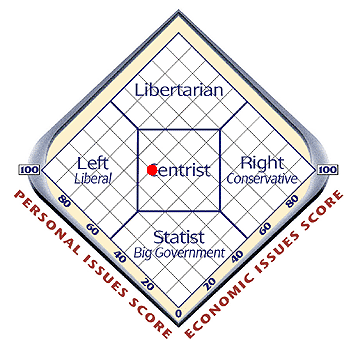
My Politics


I am a centrist in terms of political position: CENTRISTS espouse a "middle ground" regarding government control of the economy and personal behavior. Depending on the issue, they sometimes favor government intervention
and sometimes support individual freedom of choice. Centrists pride themselves on keeping an open mind, tend to oppose "political extremes," and emphasize what they describe as "practical" solutions to problems. See this interesting site!


Thanks a lot for the pointer, Greg Mankiw's blog.

Sunday, October 22, 2006

Score of 5

In September I took the test of TOEFL, Test of English as a Foreign Language. My total score is 193 of 300: This level of score is never relatively high. Especially I got score of 5 in the writing section. What does it mean? See the website of ETS, the provider of TOEFL.

Sunday, October 15, 2006

A December Hike in Rate?

The other day Mr. or Ms. anonymous asked me, "Do you think the Bank of Japan will raise rates in December?"

My answer to such a question is as follows: Tomorrow never knows. However it is more likely that BOJ will raise the interest rate before the end of the year. Here's the relevant excerpt:

Half of economists see BOJ's next rate hike by January: survey
Jiji Press, October 13, 2006

Half of the private-sector economists polled by a government affiliate expect the Bank of Japan to carry out another interest rate increase by January next year, according to the survey results released Thursday. The Economic Planning Association, affiliated with the Cabinet Office, surveyed 34 economists at private-sector financial institutions. Of them, 17 predicted the next rate hike by the central bank would come by January.

The BOJ raised its unsecured overnight call rate target in July to around 0.25 percent from almost zero percent, its first credit-tightening step since August 2000.

Of those surveyed, nine foresee the BOJ's next move coming in December this year, while five each predict the rate hike taking place in January and February next year. The earliest forecast was for November this year, backed by three of the economists.

Another excerpt:

Central bank won't decide monetary policy on consumer prices alone
Mainichi Shimbun, October 5, 2006

The Bank of Japan won't set monetary policy based on consumer prices alone, a senior bank official said Thursday."Consumer prices are important data, but we will not determine monetary policy on that alone," said Bank of Japan Deputy Governor Toshiro Muto.

"We are closely watching developments of the economy and other movements," told reporters in Kyoto, after meeting regional business leaders there. Muto also said he does not have any preconceptions about when to raise the benchmark interest rate, now at 0.25 percent.

....With prices inching up after years of deflation, analysts have been speculating about when the Bank of Japan will next raise rates. Japan's core consumer price index, which excludes volatile fresh food prices, rose 0.3 percent in August, the third monthly gain under a new, revised calculation method. Under the old system, it would have been the 10th consecutive monthly increase.

Actually Toshihiko Fukui, Governer of BOJ, told the press that BOJ would not keep the rates at the present level. Mr. Fukui didn't deny that BOJ would raise the rate. This Fukui's statement will have some influence on the people's expectation and thus the next development of the Japanese economy: Not denying a hike in the rate seems to be no better than a would-be hike. That is, it makes many people think that BOJ wants to raise the interest rate some day in the future. And the economy is likely to be shrinked by Fukui's prediction.

In fact, of those surveyed, nine economists foresee the BOJ's next move coming in December. Their conjecture will also make the people think of the next hike in the rate and thus the economy will be influenced by itself. I think Mr. Fukui knows that his policy change affects not only the economy itself but also the people's expectation on the next situation of the economy. From this viewpoint, Mr.Fukui seems to aim for a next hike in the rate. He is sure to want to raise it within the year. In any case, there will be a hike in the future.

Saturday, October 14, 2006

10,000¥ for Good Habit

There is a interesting topic about the rule and manner of the university students. Akita Keizaihoka University(Akita University of Economics and Law) made a rule to prohibit the students from dyeing their hair brown and wearing pierced earings and also proposed giving 10,000¥(about US$90) to the students who obey the rule. In order to heighten students' sence of social manner and moral and to have students conscious of being a responsible member of society, the University made a decision to ban students from brown hair and having ears pierced.

The hair of the Japanese students is generally black, which is different from that of many of the Western. And there is some resistance against students' dyeing hair brown and golden in the Japannese society. A traditional student rule in the Japanese school bans dyeing hair brown and golden and wearing pierced earings. I think it to be one of the original culures of Japanese tradition. Having black hair and not wearing pierced earings at school is thought to be a good manner and habit for students in Japan.

Surprisingly, the University made a proposal to give 10,000¥to the students who have stopped dyeing hair brown and golden and wearing pierced earings in order to have the students take a social responsibility for their behavior and habit and to have a sence of social manner.

However there are strong oppositions to such a proposal from both internal and external various kinds of people like students, teachers, journalists, pundits and so on. Some oppositions say that the earnest students can't have no reward for not dyeing hair brown and not wearing pierced earings, while the insincere students who dye hair brown and wear pierced earings can be rewarded 10,000¥.

It is natural to oppose such a ridiculous proposal, I think. The university eventually made a decision not to reward the students who have stopped dyeing hair brown and wearing pierced earings. A good choice. I think that the University needs to talk the students into not dyeing hair brown and not wearing pierced earings. However this case will create quite a stir in the educational circles.

Tuesday, October 10, 2006

2006 Nobel Prize of Economics

Columbia professor Edmund S. Phelps Wins 2006 Nobel Prize in Economics. He has studied the intertemporal tradeoffs between inflation and unemployment. He is so famous that we can see his name anywhere in many undergraduate macroeconomics textbooks. However I don't know much about his research but his name very well. I have never read his articles. I have known that he is a prominent American economist.

Here's the excerpt of the Columbia News:

Professor Edmund S. Phelps Wins 2006 Nobel Prize in Economics

Edmund S. Phelps, McVickar Professor of Political Economy at Columbia University and director, Center on Capitalism and Society at the Earth Institute, was awarded the Nobel Prize in Economics on Monday, October 9 by the Royal Swedish Academy of Sciences.
Phelps won the award – officially named the Sviriges Riksbank Prize in Economic Sciences – for his analysis of intertemporal tradeoffs in macroeconomic policy.

.....Low unemployment and low inflation are central goals of stabilization policy. During the 1950s and 1960s the view of a stable tradeoff between inflation and unemployment was established, the so-called Phillips curve. According to this, the price for reduced unemployment was a one-time increase of the inflation rate. Phelps challenged this view through a more fundamental analysis of the determination of wages and prices, taking into account problems of information in the economy. Individual agents have incomplete knowledge about the actions of others and must base their decisions on expectations. Phelps formulated the hypothesis of the expectations-augmented Phillips curve, according to which inflation depends on both unemployment and inflation expectations.

As a consequence, the long-run rate of unemployment is not affected by inflation but only determined by the functioning of the labor market. It follows that stabilization policy can only dampen short-term fluctuations in unemployment.

Hearing the news, I want to know more about Phelps' research and the relevant studies on the intertemporal tradeoffs. Recently I have read one article about the tradeoffs. I think it a good reference.

Sunday, October 08, 2006

Booming Japan

Japan is now booming. I am not feeling that, however. And so are many businesspeople, I think.

The Yomiuri Shimbun
Oct. 7, 2006

The current economic expansion phase will most likely equal that of the Izanagi boom, which was the longest continuous period of growth, lasting four years and nine months in the late 1960s.
The milestone comes as the government decided Friday to declare in its monthly economic report for October that the economy is still in the recovery phase, government sources said.
The report will be announced Thursday. The current economic expansion phase started in February 2002.
The Izanagi boom occurred in the middle of the nation's high economic growth period and lasted from November 1965 to July 1970.
In its outlook in the monthly economic report, the government will say the economic recovery supported by the domestic private-sector demand is expected to continue for a while, the sources added.

I feel it somewhat strange to hear the economy recover. Has the deflation faded away yet? I don't think so.

Tuesday, October 03, 2006

For Good Relations with China and ROK

Prime Minister Shinzo Abe and the leaders of China and South Korea have agreed to hold summit talks to improve their respective bilateral relations.

Japan gets chance to improve Asian relations as Tokyo and Seoul, Beijing agree to talks

Mainichi Shinbun
Oct. 2, 2006

Abe has made improving Tokyo's relations with Beijing and Seoul the core of his diplomatic policies. Chinese and South Korean leaders hope that Abe will play a leading role in taking concrete action in clarifying the Japanese government's view on its history of wartime atrocities in Asia, according to the sources.

However, the Chinese and South Korean governments are sticking to their demand that Abe refrain from visiting the shrine, where Class-A war criminals are enshrined among the war dead. If summit talks between Japan and China and Japan and South Korea highlight the wide gap on the Yasukuni issue and views on Japan's wartime aggressions, it could make it more difficult to improve their strained relations, observers fear.

...."China-Japan relations are at an important historical phase," Premier Wen Jiabao said, with another top official repeatedly calling for leaders to "work together" to improve bilateral relations. Observers say Tokyo may have already promised that Abe will at least make a statement on the issue during the upcoming summit meeting that will satisfy Beijing. .....As Japan and China move toward improving ties, South Korea also appears to have made a realistic decision when it also agreed to hold summit talks between Abe and President Roh Moo-hyun, the diplomatic sources said.

However, it remains to be seen whether the upcoming Japan-South Korea summit talks will be a turning point in bilateral ties. "Even if the Abe administration is inaugurated, our stance toward the Yasukuni issue will remain unchanged," a high-ranking official of the South Korean government said. Seoul has also urged Japan to take "sincere action" to clarify its interpretation of history, specifically the brutal acts committed during the Japanese occupation of the Korean Peninsula during World War II.

Anyway, Abe should not visit Yasukuni shrine, which will solve the problems between China, ROK and Japan in the end. However I don't think so. The difficulties could not be overcome as long as China and ROK play the role of the heroine of tragedy. As far as Abe doesn't insist on his ideas about the visit to Yasukuni and his interpretation of the Japanese aggression history, Japan could not have China and ROK understand well what it will do for improving the relations with China and ROK.

What This Recovery Tells

Business confidence among major manufacturers has improved, according to the Bank of Japan's closely watched Tankan economic outlook survey for September.The survey showed business confidence among major manufacturers up three points to plus 24 in the key diffusion index (DI) for the second straight quarterly rise.

The DI figure is calculated by subtracting the percentage of companies reporting unfavorable business conditions from that of those reporting favorable conditions. BOJ announces the Tankan survey every three months. The latest survey was conducted from Aug. 30 to Sept. 29, covering 9,863 firms.

Here's the excerpt:

The Yomiuri Shimbun
Oct. 3, 2006

The first survey since the central bank ended its five-year zero-interest policy in July confirmed the steady overall economic improvement was sustained even with the interest rate above zero. Analysts said the figures were above market expectations, and that the result might encourage the central bank to go forward with another interest rate increase in coming months.

The improvement in business sentiment was especially notable in raw material-related industries and exporters that benefitted from declining oil prices and a weaker yen. The survey also showed a rise in corporate manager sentiments that there are human resource shortages.

.....As for capital investment in plants and equipment, major manufacturers in all industries planned to spend an average of 11.5 percent more in fiscal 2006 than the previous year. The figure was at the highest level since fiscal 1990's September survey, near the height of the nation's bubble economy.

The employment index, which is calculated by subtracting the percentage of companies reporting underemployment from that of those reporting overemployment, was three points down from the previous survey at minus eight for all industries of all sizes, meaning that more companies are becoming shorthanded. This feeling of employment shortage was the greatest since August 1992.

The biggest contributor to the improvement in major manufacturers' business sentiment was the strong performance of raw material industries. The slowdown in crude oil prices helped raw material firms such as steel and nonferrous metal makers turn profits, while also succeeding in passing on earlier high oil costs in sales prices. The DI figure for steel manufacturers rose 14 points to plus 53, and rose 13 points to plus 41 for nonferrous metal makers.

Though small and midsize companies lag big firms in business sentiment, their projection for capital investment reflected growing optimism among corporate managers.

The concern now is the deceleration of the U.S. economy. Japan's exporters may lose momentum if demands abroad continue to slow down. Some analysts even think the nation's economy has already peaked, and are alarmed another interest rate increase could severely hurt the financing of small and midsize companies.

According to the above excerpt, there are mainly three characteristics of the recent recovery of the Japanese economy:

(1) The improvement in raw material-related industries and exporters

The slowdown in crude oil prices enabled raw material firms such as steel and nonferrous metal makers to turn profits, while also passing on earlier high oil costs in sales prices. Declining oil prices, a weaker yen and booming China and US boost up the exporters.

(2) The employment shortage for all industries of all sizes

More companies are feeling shorthanded. It seems that the Japanese economy is picking up. This is, however, rather the sign that Japanese economy is becoming aged: The number of retiree is sure to increase, while decreasing younger workers. So many companies need hiring workers so as not to face the shortage of human resource.

(3) Weaker sentiment in small and midsize companies

This recovery might be merely big firms'. Many small and midsize companies might not be benefitting from this recovery. Most of all companies in Japan are small and midsize ones, which is, in terms of the number of firms, about 70 percent of all firms. In this regard, the increasing profit from the recovery is unlikely to be distributed fairly among most companies and workers. It can say that it is far from the true recovery that improves the life of every member of our economy.